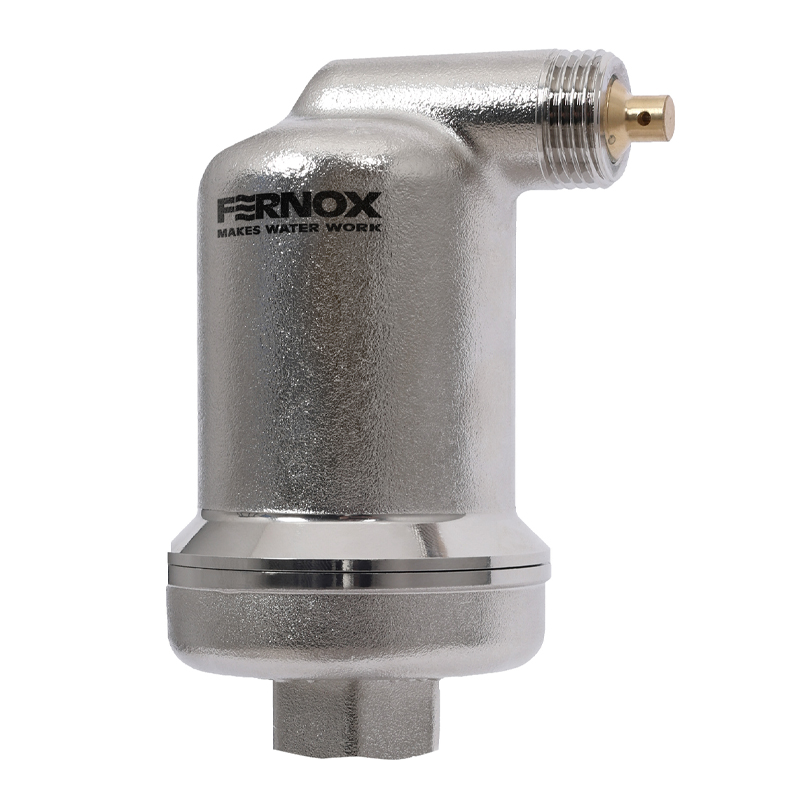
The Fernox CA1 Automatic Air Vent is designed to automatically release unwanted air and microbubbles from closed-loop heating and cooling systems. It helps reduce system noise, prevent airlocks, and maintain efficient circulation. Its vertical design allows it to be installed at the highest points where air tends to accumulate. The unit is constructed from nickel-coated brass, features a float-controlled vent mechanism, and operates without requiring external power or regular servicing.
Float-controlled automatic air release mechanism
Vertical installation only – ensures air separation performance
Nickel-plated brass body for long-term durability and corrosion resistance.
Suitable for water and water/glycol mixtures (up to 50% glycol)
Robust polypropylene float designed for long service life
Supplied with a removable ½” cap to allow system pressure testing during commissioning.
– Suitable for closed-loop heating and chilled water systems
– Intended for installation at the highest point of the system, or locations where air pockets are likely to form
– Installed vertically, with connection at the bottom and a 2° maximum inclination
– Must remain accessible for operation and testing
– Not suitable for outdoor installations or use with flammable, oil-based, or drinking water systems
Fernox CA1 Automatic Air Vent ensures the continuous discharge of entrapped air and dissolved gases from HVAC systems. Its float activates the venting mechanism once sufficient air accumulates within the chamber. The vent can be used in heating or chilled water systems and is compatible with water-glycol mixtures (up to 50%).
The design includes a ½” BSP male connection and a vertical orientation requirement with a slight installation gradient (2° max). No electrical or manual intervention is required during operation.
Physical Specification / Properties
Body Material: Nickel-coated brass
Internal Components: Stainless steel
Float: Polypropylene
Connection size: ½” BSP male
Installation Angle: Vertical (≤ 2° incline)
Dimensions (approx.):
• Height: 107 mm
• Diameter: 58 mm
• Weight: 0.64 kg
Package, Handling & Safety
Each unit is individually tested and supplied ready for installation. Product must be depressurised and cooled before servicing. Not suitable for outdoor use. Ensure that the air valve remains unobstructed during and after installation. Product must not be used for flammable liquids, drinking water, or oil. Improper installation voids the warranty. Handle with care when working at high temperatures.
Product Code
33006235
Performance
Working Pressure: 0-10 bar
Working Temperature Range: 0 – 110°C
Fluids Supported:
• Water
• Glycol-water mixtures (up to 50%)
Installation Orientation: Vertical only (max 2° gradient)
Connection: ½” male BSP
Weight: 0.64kg
Operating Principle
As air accumulates at high points in the system, it enters the vent chamber. The internal float drops as air displaces the fluid inside. The venting mechanism is then activated, releasing the trapped air through the outlet. As fluid returns, the float rises and reseals the valve. This process is automatic and continuous, requiring no manual adjustment.