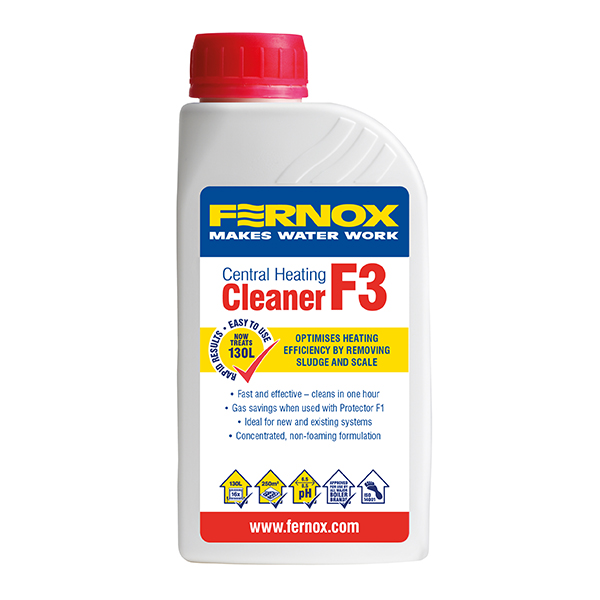
Cleaner F3 500ml

Product Code:
56600

Cleaner F3 is an effective, universal pH neutral, non-foaming liquid cleaner, which removes sludge, scale and debris from existing central heating systems to restore heating efficiency and eliminate boiler noise. When commissioning new systems in accordance with BS 7593:2019 regulations and best practice, Cleaner F3 is ideal to remove flux residues and other installation debris to help extend the life of the boiler and the efficiency of the system. It is suitable for use when powerflushing to accelerate the cleaning process in existing and contaminated systems. Cleaner F3 is a non-hazardous product which is compatible with all metals commonly used in heating systems, including aluminium.

  • One 500ml bottle treats 130 litre system, up to 16 radiators, or 250 sqm of underfloor heating
  • Removes sludge, limescale and other debris to restore energy efficiency and extend system and boiler life
  • When used in conjunction with Protector F1 gas savings of up to 15% can be achieved every time you heat your room
  • pH Neutral, non-hazardous, non-foaming formula, which is fast and easy to remove from the system – saving time on-site
  • Compatible with all metals and materials commonly used in heating systems, including aluminium
  • Effective, universal cleaner for pre-commissioning new and existing heating systems
Application

A single dose of Cleaner F3 treats a larger sized property with a heating system of 130 litres, up to 16 radiators, or 250 sqm of underfloor heating. Additional/repeat applications of Cleaner F3 may be necessary for larger systems, or if systems are heavily sludged. Alternatively, Power Cleaner F8 may be used for heavily sludged systems.

First drain and refill the entire system with plain water. For optimum results the entire system, including drop feed radiators where fitted, should be completely drainable. Preferably, full bore gate valves with hose connectors should be provided temporarily for this purpose. Motorised and thermostatically controlled valves must be set so that no part of the system is closed off during cleansing, or rinsing. Discharges must be made to the foul drain and not the surface water drain. For open vented systems add Cleaner F3 via the header tank. For sealed systems add via a suitable dosing point, or use Fernox Cleaner F3 Express 400ml.

Fernox Cleaner F3 can also be used in conjunction with a powerflushing unit. In this case, please refer to the unit manufacturer’s instructions. When pre-commission cleansing new systems, Fernox Cleaner F3 should be circulated for a minimum of one hour at normal operating temperature. For cleaning existing systems, sludge and debris should be dispersed also within one hour at normal operating temperatures. However, to remove hardened iron oxides and limescale, the cleaning time can be extended to up to one week under the normal heating cycle. If a radiator still has a cold spot after one hour, increase the flow through the radiator by closing the valves on the other radiators.

An additional or repeat dose of Cleaner F3 may be necessary in some cases. Drain and flush thoroughly, at least twice, until the water runs clear. When using Cleaner F3 with a powerflushing machine, cleaning should be completed within an hour. Use dynamic flushing with plain water until the water is clear. Refill the system adding Fernox Protector F1 for long term protection against corrosion and limescale. In single feed indirect cylinders, e.g.’Primatic’or similar, potable water chemicals must be used.

“Cleaning a central heating system using Fernox F3 Cleaner and protecting with Fernox F1 Protector can restore and maintain system efficiency, resulting in a gas saving of up to 15% every time you heat your room. This saving is equivalent to 110 Kg CO2e per typical home per year.”*
*independently verified

Physical Properties

Colour: Amber
Odour: Faintly aromatic
Form: Liquid
pH (conc): 6.4
pH (in-use) 6.5 – 7.7
SG: 1.145 @ 20°C

Package & Handling

Fernox Cleaner F3 is supplied in 500 ml bottles.

Fernox Cleaner F3 is classified as non-hazardous for human health, but as with all chemicals, keep out of reach of children. In case of contact with eyes or skin, rinse immediately with plenty of water.

Volumetrics
Product CodeSingle Unit BarcodeSingle Unit Dimensions (Depth x Width x Height)Single Unit Weight(Kg)Outer Carton Barcode (ITF)Outer Carton Dimensions (Height x Width x Depth)Outer Carton Box Weight(Kg)
56600
5014551566002
182 x 88 x 52 mm
0.60
05014551000711
195 x 268 x 182 mm
6.13
Downloads
Frequently Asked Questions
Soft and hard limescale on radiator walls can drastically reduce their ability to heat rooms efficiently. The problem often revolves around the boiler heat exchanger where the temperature is hottest, but deposits in radiators and pipework also lessen the effectiveness of the whole system. It is therefore important to consider the whole central heating system when checking and establishing why its efficiency has dropped. What causes fuel wastage? There are two main forms of deposits found in heating systems: Part L of the Building Regulations for England and Wales 2006 states that new all wet central heating systems should be pre-commission cleaned and treated with a central heating inhibitor. The correct method for inhibiting a central heating system is explained in a British Standard Code of Practice BS 7593:2006. If the cleanliness of a central heating system is maintained from the start, its life span can be extended as well as design efficiency optimised. However, if the efficiency of an existing system has been reduced due to a lack of cleaning or insufficient inhibition protection, remedial action should be taken. Fernox Cleaner F3 and Fernox Powerflushing Cleaner F5 are both designed to recondition systems and are particularly effective if the system is contaminated with black iron oxide sludge. Fernox DS40 System Cleaner should be used if limescale deposition is evident. However, it is important to note that cleaning or descaling will never fully restore the heating system to its original condition. After cleaning, the system should be protected against further corrosion or scaling by using Fernox Protector F1 or Fernox Protector MB-1, or in systems where a system filter has been installed, Fernox Protector + Filter Fluid can be used.
  • In hard water areas, limescale forms mainly on the hottest surfaces. Low water content and tubular boilers are particularly prone. High skin temperatures can attract lime even from relatively soft waters, but these are unlikely to cause limescale problems. However, temperature is not the only factor that can promote limescale deposition. The design of components or choice of material and surface finish can all increase or decrease the probability of scaling. As modern condensing boilers have far narrower flow channels in the heat exchanger than older cast iron boilers, less deposition is required to cause noticeably detrimental effects to system performance. Limescale deposition that affects system performance can begin from waters containing as little as 100ppm of hardness.
  • Black iron oxide sludge is produced continuously in all untreated installations, even in the near absence of air or dissolved oxygen, mainly due to electrolytic corrosion. If there are higher levels of dissolved oxygen (perhaps because of an aeration fault) it compounds the problem. Iron oxide is five times heavier than water and settles in areas of reduced flow such as radiators.
As well as wasting fuel, these deposits cause other problems such as boiler noise and component failure, notably relating to circulator pumps and boiler heat exchangers. Part L of the Building Regulations for England and Wales 2006 states that new all wet central heating systems should be pre-commission cleaned and treated with a central heating inhibitor. The correct method for inhibiting a central heating system is explained in a British Standard Code of Practice BS 7593:2006. If the cleanliness of a central heating system is maintained from the start, its life span can be extended as well as design efficiency optimised. However, if the efficiency of an existing system has been reduced due to a lack of cleaning or insufficient inhibition protection, remedial action should be taken. Fernox Cleaner F3 and Fernox Powerflushing Cleaner F5 are both designed to recondition systems and are particularly effective if the system is contaminated with black iron oxide sludge. Fernox DS40 System Cleaner should be used if limescale deposition is evident. However, it is important to note that cleaning or descaling will never fully restore the heating system to its original condition. After cleaning, the system should be protected against further corrosion or scaling by using Fernox Protector F1 or Fernox Protector MB-1, or in systems where a system filter has been installed, Fernox Filter Fluid+ Protector can be used.
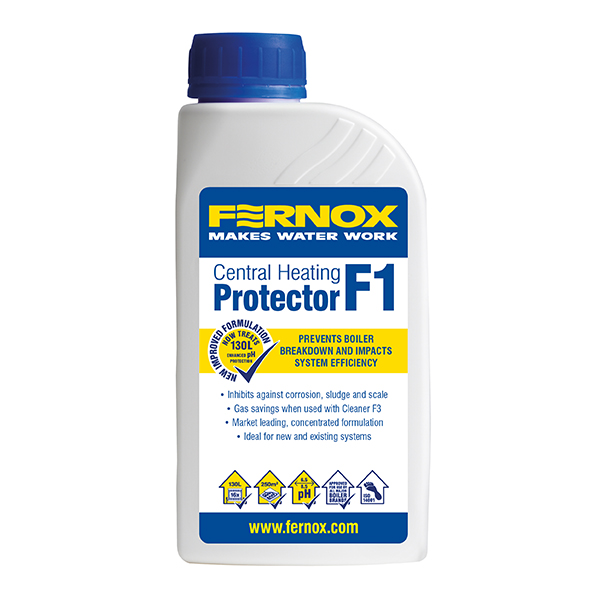
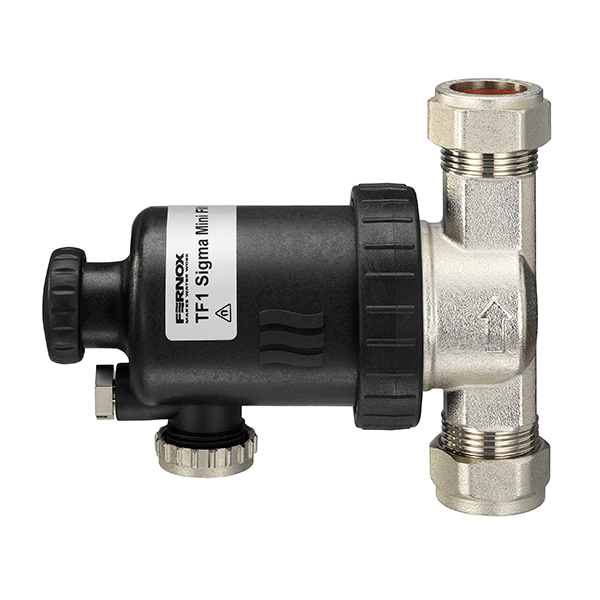
Fernox Cleaner F3 should ideally circulate through the system for at least one hour, or up to a week. Afterward, it should be drained, and the system flushed and cleaned before adding Fernox Protector F1 or Protector + Filter Fluid, together with a Fernox TF1 Filter, to protect the system from further corrosion and scale formation.
Videos
How do Fernox Cleaners work

Featured Products