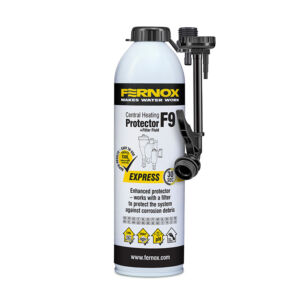
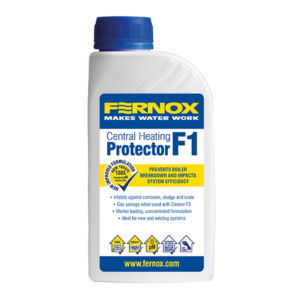
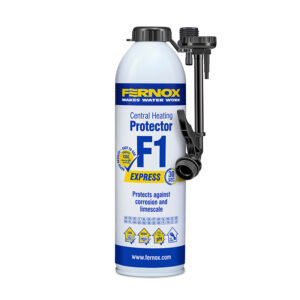
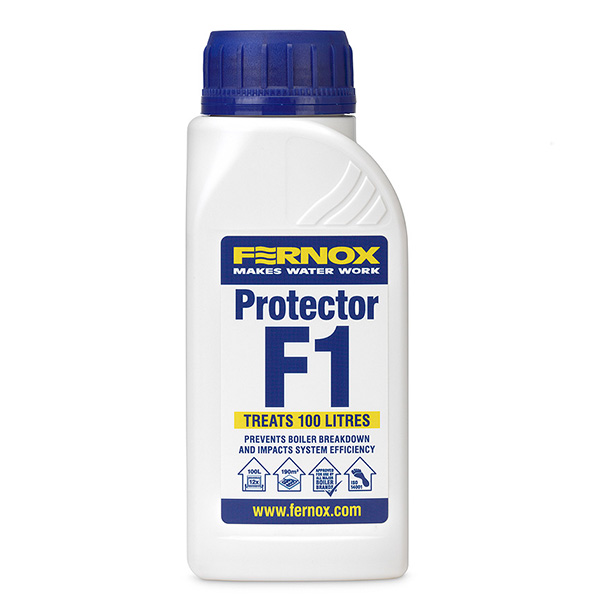
Protector F1 265ml

Product Code:
62454

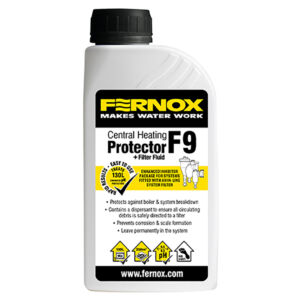
Fernox Protector F1 265ml gives long-term protection against internal corrosion and limescale formation in central heating systems. Suitable for all types of boilers, radiators and pipework systems, this product is compatible with all metals and materials commonly used in central heating systems, including aluminium.

Part of the Fernox tried and trusted Protector F1 range, this 265ml product offers reduced packaging and waste without compromising on high performance, quality and ease of use. This conveniently size bottle can treat an average 100 litre system or 12 radiators and maybe dosed via a TF1 Filter.

To comply with BS 7593:2019 and best practice, Protector F1 levels should be checked annually as part of the maintenance service. The concentration of the product to ensure full protection can be easily measured on-site using a Fernox Protector Test Kit or by using the Fernox Water Quality Test postal service, with samples submitted via a mobile App.

BS 7593:2019 also states that after five years, systems should either be re-dosed with inhibitor or the quality/ cleanliness of the system water checked by a laboratory test, such as the Fernox Water Quality Test.

If you protect a central heating system using Fernox Protector F1, after cleaning with Fernox Cleaner F3, you can restore and maintain system efficiency resulting in a gas saving of up to 15% every time you heat your room.

  • Stops corrosion and scale to extend system life and efficiency
  • Use in mixed metal heating systems, including aluminium
  • High performance pH buffering for optimum system pH control
  • Prevents radiator cold spots, sticking pumps and boiler noise
  • Treats an average sized UK home of up to 100L, 12 radiators and 190 sqm of underfloor heating. Smaller volume product – less packaging waste and lower environmental impact.
  • Can be conveniently dosed via any Fernox TF1 Filter
Application

The recommended ‘in use’ concentration of the product is 0.265%. One 265 ml bottle will treat an average domestic system (100 litres). For open vented systems add via the feed and expansion tank. For sealed systems add via a suitable dosing point (e.g. a towel rail or an in-line TF1 system filter). Alternatively, use a suitable dosing vessel to inject the product into the system. In single feed indirect cylinders, e.g.’Primatic’ or similar, potable water chemicals must be used. Fernox recommends untreated or sludged systems are thoroughly cleaned and flushed in accordance with BS 7593:2019 and Benchmark using any product from the Fernox Cleaner range, before treating with Fernox Protector F1, as existing debris can damage the installation and may reduce the lifespan of the boiler and system.

Physical Properties

Protector F1 is a blend of inorganic and organic corrosion and scale inhibitors.
Form: Liquid
Odour: Aromatic (slight)
Colour: Light Yellow
pH(conc.): 8.3
pH(soln.): 7.8 to 8.5
SG: 1.135 at 20°C

Package & Handling

Fernox Protector F1 is supplied in 265 ml bottles.

Fernox Protector F1 is classified as non-hazardous for human health, but as with all chemicals, keep out of reach of children. In case of contact with eyes or skin, rinse immediately with plenty of water.
Volumetrics
Product CodeSingle Unit BarcodeSingle Unit Dimensions (Depth x Width x Height)Single Unit Weight(Kg)Outer Carton Barcode (ITF)Outer Carton Dimensions (Height x Width x Depth)Outer Carton Box Weight(Kg)
62454
5014551624542
148 x 60 x 47 mm
0.27
05014551001985
241 x 178 x 127 mm
3.62
Downloads
Frequently Asked Questions
Soft and hard limescale on radiator walls can drastically reduce their ability to heat rooms efficiently. The problem often revolves around the boiler heat exchanger where the temperature is hottest, but deposits in radiators and pipework also lessen the effectiveness of the whole system. It is therefore important to consider the whole central heating system when checking and establishing why its efficiency has dropped. What causes fuel wastage? There are two main forms of deposits found in heating systems: Part L of the Building Regulations for England and Wales 2006 states that new all wet central heating systems should be pre-commission cleaned and treated with a central heating inhibitor. The correct method for inhibiting a central heating system is explained in a British Standard Code of Practice BS 7593:2006. If the cleanliness of a central heating system is maintained from the start, its life span can be extended as well as design efficiency optimised. However, if the efficiency of an existing system has been reduced due to a lack of cleaning or insufficient inhibition protection, remedial action should be taken. Fernox Cleaner F3 and Fernox Powerflushing Cleaner F5 are both designed to recondition systems and are particularly effective if the system is contaminated with black iron oxide sludge. Fernox DS40 System Cleaner should be used if limescale deposition is evident. However, it is important to note that cleaning or descaling will never fully restore the heating system to its original condition. After cleaning, the system should be protected against further corrosion or scaling by using Fernox Protector F1 or Fernox Protector MB-1, or in systems where a system filter has been installed, Fernox Protector + Filter Fluid can be used.
  • In hard water areas, limescale forms mainly on the hottest surfaces. Low water content and tubular boilers are particularly prone. High skin temperatures can attract lime even from relatively soft waters, but these are unlikely to cause limescale problems. However, temperature is not the only factor that can promote limescale deposition. The design of components or choice of material and surface finish can all increase or decrease the probability of scaling. As modern condensing boilers have far narrower flow channels in the heat exchanger than older cast iron boilers, less deposition is required to cause noticeably detrimental effects to system performance. Limescale deposition that affects system performance can begin from waters containing as little as 100ppm of hardness.
  • Black iron oxide sludge is produced continuously in all untreated installations, even in the near absence of air or dissolved oxygen, mainly due to electrolytic corrosion. If there are higher levels of dissolved oxygen (perhaps because of an aeration fault) it compounds the problem. Iron oxide is five times heavier than water and settles in areas of reduced flow such as radiators.
As well as wasting fuel, these deposits cause other problems such as boiler noise and component failure, notably relating to circulator pumps and boiler heat exchangers. Part L of the Building Regulations for England and Wales 2006 states that new all wet central heating systems should be pre-commission cleaned and treated with a central heating inhibitor. The correct method for inhibiting a central heating system is explained in a British Standard Code of Practice BS 7593:2006. If the cleanliness of a central heating system is maintained from the start, its life span can be extended as well as design efficiency optimised. However, if the efficiency of an existing system has been reduced due to a lack of cleaning or insufficient inhibition protection, remedial action should be taken. Fernox Cleaner F3 and Fernox Powerflushing Cleaner F5 are both designed to recondition systems and are particularly effective if the system is contaminated with black iron oxide sludge. Fernox DS40 System Cleaner should be used if limescale deposition is evident. However, it is important to note that cleaning or descaling will never fully restore the heating system to its original condition. After cleaning, the system should be protected against further corrosion or scaling by using Fernox Protector F1 or Fernox Protector MB-1, or in systems where a system filter has been installed, Fernox Filter Fluid+ Protector can be used.
One bottle of Fernox Protector F1 or Protector + Filter Fluid will treat a typical system of ten single panel radiators – double panel radiators, count as two radiators. If the calculated dose rate is in between pack sizes, dose to the higher figure.
No, overdosing is not detrimental to the system. It is important to ensure that sufficient Protector is present in the system. There is a test kit and a postal testing service to check the Protector concentration. Refer to Protector Test Kit product data sheet for further guidance.
Videos
How do Fernox Inhibitors perform_ Fernox vs BuildCert
Scale Formation 24-hour Time-lapse (The Power of Fernox F1 Protector)
How does Fernox Protector F1 work

Featured Products